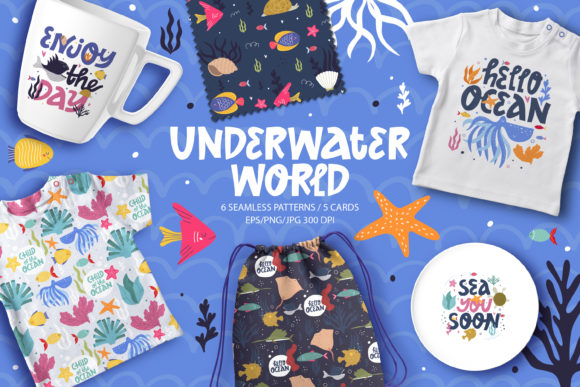
Underwater World Digital Papers and Card: A Versatile Design Resource for Creative Projects
The Underwater World Digital Papers and Card collection offers a unique blend of visual elements that can elevate the design of digital and print projects. This set is particularly appealing to designers, educators, and hobbyists looking for high-quality, thematic resources that are both functional and aesthetically pleasing. With 6 EPS JPG seamless patterns and 5 EPS JPG PNG cards, this collection provides flexibility for a wide range of creative applications.
Understanding the Underwater World Collection
The Underwater World Digital Papers and Card set is designed with a focus on realism and detail, capturing the essence of marine environments. Each pattern and card is crafted to reflect the beauty of underwater landscapes, from coral reefs to deep-sea creatures. These designs are available in multiple formats, including EPS, JPG, and PNG, ensuring compatibility with various design software and printing needs.
The inclusion of High Res 300 DPI files makes this collection ideal for professional-grade prints, such as invitations, packaging, or educational materials. The seamless patterns are perfect for backgrounds, while the cards can be used as standalone elements or combined with other design components.
What Sets This Collection Apart
Compared to similar design resources, the Underwater World Digital Papers and Card stands out due to its attention to detail and thematic consistency. Many digital paper collections focus on broad themes without delving into specific elements, but this set captures the nuances of underwater life effectively. Whether you're designing a marine-themed event invitation or creating educational content about ocean ecosystems, these resources provide a cohesive look.
The versatility of the EPS format allows for scalability without loss of quality, making it suitable for both small and large-scale projects. Additionally, the availability of PNG files ensures transparency options, which can be useful when layering elements in graphic design software.
Comparing with Other Digital Paper Collections
When evaluating the Underwater World Digital Papers and Card against other digital paper sets, it's important to consider factors such as resolution, file formats, and thematic depth. Some collections may offer more variety in terms of patterns or include additional elements like clipart or icons, but they might lack the focused theme that makes this set distinctive.
For example, general-purpose digital paper collections often feature abstract patterns or nature scenes without a specific focus. In contrast, the Underwater World set maintains a consistent aesthetic throughout, which can be advantageous when working on projects that require a unified visual identity.
Designers who prioritize ease of use may find that some collections come with bundled templates or tutorials, which can be a helpful addition. However, the Underwater World set focuses on providing high-quality assets rather than extra tools, making it more suitable for those who already have a workflow in place.
Best-Fit Situations for This Collection
The Underwater World Digital Papers and Card is particularly well-suited for projects that benefit from a thematic, immersive design. This includes:
- Event Invitations: Marine-themed weddings, birthdays, or corporate events can use these papers to create a unique and engaging visual experience.
- Educational Materials: Teachers and educators can incorporate these designs into presentations, worksheets, or interactive learning modules about ocean life.
- Printed Merchandise: From t-shirts to notebooks, these patterns can add an artistic touch to branded products.
- Digital Presentations: Backgrounds and visual elements in slideshows or online courses can be enhanced using these high-resolution files.
However, if your project requires a broader range of design elements or more diverse themes, you may need to explore other collections that offer greater variety.
Considerations and Tradeoffs
While the Underwater World Digital Papers and Card is a strong option for themed design work, there are certain limitations to be aware of. For instance, the collection does not include additional design elements such as vector illustrations or editable text layers. This means that users will need to integrate these assets into their existing design workflows.
Additionally, the price point may be a consideration for those who are looking for budget-friendly options. While the quality justifies the cost for many professionals, it may not be the most economical choice for casual users or those experimenting with different styles.
If you're working on a project that requires frequent changes or customization, the fixed nature of these pre-designed elements could be a drawback. In such cases, using a design tool that allows for more flexibility might be more appropriate.
Practical Examples and Use Cases
To illustrate how the Underwater World Digital Papers and Card can be applied in real-world scenarios, consider the following examples:
- Creating a Themed Website: A marine conservation organization could use these seamless patterns as background elements to reinforce the site’s message and visual identity.
- Designing Educational Posters: Teachers can enhance classroom materials by incorporating these cards and patterns into posters or handouts about marine biology.
- Producing Event Materials: A scuba diving club hosting an event could use these designs for flyers, banners, or social media graphics to attract attendees.
These examples highlight how the collection can be adapted to different contexts, depending on the designer’s vision and the project’s requirements.
In conclusion, the Underwater World Digital Papers and Card is a valuable resource for anyone seeking high-quality, thematically consistent design elements. Its strengths lie in its attention to detail, versatility in file formats, and suitability for a wide range of projects. However, it is important to weigh these benefits against potential limitations, such as the absence of additional design elements and the need for integration into existing workflows.